The outer cylinder of a steam turbine has a huge volume and astonishing weight, and its lifting operation is one of the most challenging high-risk links in power plant maintenance. When the crane in the main factory building cannot lift it alone, multiple chain hoists are used to assist in tightening and fixing, which becomes a key process for safe and smooth lifting.
Before starting the homework, it is necessary to accurately calculate and arrange each lifting point based on the distribution of the center of gravity of the outer cylinder. Usually, corresponding tonnage hoists are installed at the four corners and longitudinal middle section of the cylinder body, with sufficient safety margin for their rated load. After the lifting instruction is issued, the main crane hook slowly lifts, and at this time, multiple chain hoist operators need to follow unified command and tighten the chains synchronously. This step is crucial - multiple gourds work together not to "lift", but to "correct" and "stabilize". By adjusting the tightness of each hoist in real time, it can effectively suppress the inclination of the cylinder body caused by the center of gravity deviation, ensure that the joint surface is horizontal and evenly stressed, and avoid jamming or damaging internal precision components.
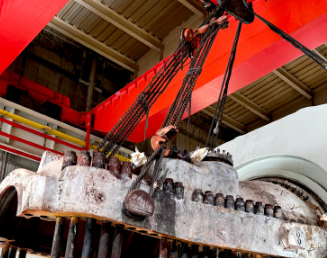
When the outer cylinder is separated from the lower cylinder by about 5 to 10 millimeters, a strict hover inspection must be performed. Only after confirming that all hoisting equipment is under normal stress and there are no signs of slippage in the hoist brake, can the formal lifting phase be entered. Throughout the entire process, the safety guardian must constantly monitor the tightness of the hoist chain and the deformation of the lifting ears, and strictly prohibit any unrelated personnel from entering the lifting area. Finally, with the fine-tuning function of the assistant hoist, the outer cylinder was smoothly raised to the predetermined height and safely turned towards the maintenance platform.
This seemingly "primitive" chain hoist lifting method is actually a crystallization of technology and experience. It uses the most reliable mechanical locking principle to solve the problem of center of gravity when lifting large workpieces, providing the most solid guarantee for the safe disassembly of the steam turbine body. Every perfect lifting is backed by a profound understanding of mechanical principles and an absolute reverence for safety regulations.

